Buddhism during Post-Vedic Period in 6th century BCE :
Buddhism is a religion with over 520 million followers i.e. over 7% of the global population, known as Buddhists. Buddhism comprises of a variety of traditions, beliefs and spiritual practices largely based on original teachings attributed to Lord Buddha and his interpreted philosophies. Buddhism originated in ancient India as a Sramana tradition in the time around 6th and 4th centuries BCE, spreading through much of Asia.
Spread of Buddhism in Ancient India [6th Century BCE – 4th Century BCE]
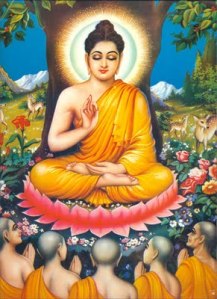
-
This religion was started by Lord Gautama Buddha whose childhood name was Siddhartha Gautama.
-
He was born in 563 BCE in Lumbini near Kapil Vastu which is presently in Nepal.
-
His father’s name was Suddhodana and his mother’s name was Maya Devi. His wife’s name was Yashodhara.
-
His foster mother’s (the person who didnot give birth to a child but brought him up right from his childhood) name was Prajapati Gautami.
-
Buddha was born in a Kshtatriya family who belonged to Shakya of Kapilvastu. Later he went on to become Shakyamuni (Sage of Shakyas).
Click here for lithic age notes
-
Once Gautama Buddha, the founder of Buddhism went for a visit in his state where he saw four scenes: an old man, a sickman, a dead body and an ascetic (sanyashi). These four scenes brought drastic change in Buddha’s mind.
-
He then left his home at the age of 29 years in search of truth and started travelling. This was called a Great Renunciation.
-
He searched for truth for almost 6 years and then he attained enlightenment through ‘Meditation’ under his master ‘Alara Kalama’.
-
He meditated under peepal tree which was called BodhiBrishk in Gaya (Bodhgaya).
-
He attained state of enlightenment under this peepal tree and his name was given Buddha after this and the tree’s name fell BodhiBrishk after his name.
-
The Peepal tree under which Buddha attained enlightenment is situated by the bank of river Neranjana.
Click here for Indus Valley Civilization notes
-
There are four famous pilgrimage sites of Buddhism :
i. BodhGaya – The place where Gautama Buddha attained enlightenment or Nirvana.
ii. Lumbini – The place where Gautama Buddha was born.
iii. Kusinagar – The place where Gautama Buddha died.
iv. Sarnath – The place where he had his first Sermon. -
Nirvana is a transcendent state in which there is neither suffering, desire nor sense of self, and the subject is released from the effects of Karma and the cycle of death and rebirth. It represents the final goal of Buddhism. It also has another term Moksha.
-
The most visited pilgrimage site of Buddhism is Bodh Gaya.
-
In sarnath, Buddha gave his first Sermon which was called ‘Dharmachakra Parivartan’ i.e. Turning the wheel of law.
-
Gautam Buddha died in Kusinagar which was the capital of ‘Malla’ Mahajanapada in 483 BCE.
-
After Lord Buddha’s death, Buddhist Council was held in 483 BCE.
Click here for Vedic Age Notes
-
Teachings of Buddha :-
Four Noble Truths :
i. World is full of sorrows.
ii. Sorrows are caused by desire.
iii. If desire are controlled, then there will be no sorrow.
iv. To follow Eight fold path (Astangika Marg). Also called Middle Path. -
Gautam Buddha rejected Vedic Rituals and ceremonies and also the Caste System from Buddhism.
-
Buddha founded Sangha i.e. order of Monks –
i. First Monk – Gautam Buddha.
ii. First Nun (Female Monk) – Prajapati Gautami. -
His first disciple was Ananda.
 SSC RRB Notes